
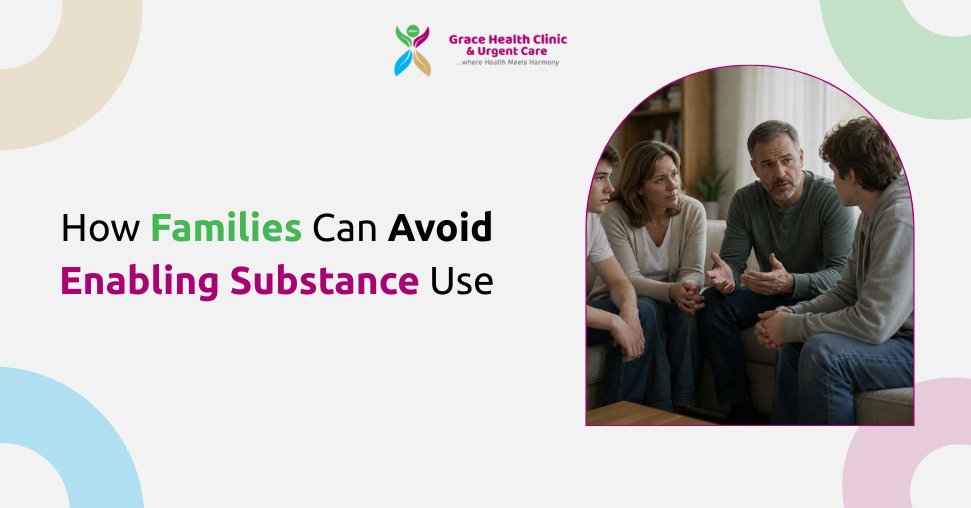
Families love each other. When someone you love uses drugs or drinks too much alcohol, you want to help. You want to make things better. But sometimes, the things we do to help can actually make the problem worse. This is called enabling.
Enabling means doing things that let the person keep using substances without facing the real results of their actions. You might think you are helping, but you are really making it easier for them to stay sick.
At Grace Health Clinic & Urgent Care, we provide compassionate medical support and guidance for individuals and families who need help.
Below, we will help you understand what enabling looks like. We will give you simple ways to stop enabling and start really helping your family member.
Common Enabling Behaviors
Enabling can be hard to see because it comes from love. You care about your family member. You do not want them to suffer. But some actions that seem kind are actually harmful.
Here are some common ways families enable substance use:
Making Excuses
You tell the boss they are sick when they are really hungover. You tell friends they cannot come because they are tired. You cover up the truth to protect them from shame.
Giving Money
You give them cash for food or rent. But you know they might use it for drugs or alcohol. You hope they will use it the right way, but deep down, you are not sure.
Paying Their Bills
You pay their rent, car payment, or phone bill. You do this so they do not lose everything. But this takes away the pressure that might make them want to change.
Doing Their Chores
You clean their room, do their laundry, or take care of their kids. You do this because they are too tired or sick to do it themselves. But this lets them keep using without any trouble.
Bailing Them Out
They get in trouble with the law or with money. You step in and fix it. You pay the fines or hire the lawyer. They do not have to face what they did.
Ignoring the Problem
You pretend nothing is wrong. You do not talk about the drinking or drug use. You hope it will just go away on its own. But it never does.
These actions come from a good place. You love them. You are scared. But these actions let the person keep using. They never have to feel the pain that could push them to get help.
Why Do Families Enable?
Families enable for many reasons. Understanding these reasons can help you stop.
Fear
You are afraid of what will happen if you stop helping. Will they lose their home? Will they go to jail? Will they get hurt? Fear keeps you stuck.
Guilt
You feel bad. Maybe you think you caused this. Maybe you think you should have done more. Guilt makes you keep giving and giving.
Love
You love this person. You want to protect them. You do not want to see them suffer. Love makes you want to fix everything.
Hope
You keep thinking this time will be different. You give them one more chance. You hope they will change. But hope without action does not help.
Not Knowing What Else to Do
You do not know how to really help. So, you do the only thing you know. You give and give and hope it works.
These feelings are normal. But they can keep your family stuck in a bad cycle.
How Families Can Avoid Enabling Substance Use
Stopping enabling is hard. It takes courage. But it is the best thing you can do for your family member.
Support and enabling are not the same thing.
Support helps your loved one become stronger. Enabling allows harmful actions to continue.
Here are steps families can take:
Learn About Substance Use
The first step is learning.
Substance use disorder is a health condition. It is not simply a bad choice or a weakness.
Learning more can help you understand what your loved one is going through.
You can:
- Read trusted information
- Talk with healthcare providers
- Join family support groups
Knowledge helps you make better decisions.
Set Clear Rules
Rules are important. They keep everyone safe. They also show your family member that you mean business.
Make rules that are simple and clear. For example:
- No drugs or alcohol in my house
- I will not give you money
- I will not lie for you
- You must go to treatment to live here
Write the rules down. Make sure everyone understands them.
Follow Through Consistently
Making rules is only half the job; enforcing them is the real challenge.
If you say no money, do not give money.
Say no drugs in the house, and do not let them in.
When you don’t keep your rules, your family member won’t be taken seriously.
Saying no may feel harsh, but it’s an act of love. It shows you care enough to stop the cycle.
Let Them Face Consequences
This is tough for parents and partners. You want to protect them, but facing consequences helps people learn.
If they lose their job for being drunk, let them.
If they get a ticket, let them pay it.
If they can’t pay their rent, let them sort it out.
These consequences aren’t punishments; they are part of reality. They show your family member that their actions have effects. This pain might be what drives them to seek help.
Take Care of Yourself
When you are helping someone with substance use, you can forget about yourself. You feel tired, sad and sick.
You need to take care of your own health.
Make time for:
- Proper nutrition and sleep
- Connecting with friends
- Activities that bring you joy
You cannot help anyone if you are falling apart. Taking care of yourself is not selfish. It is necessary.
Do Not Ignore the Need for Professional Help
Substance use disorders are intricate health issues. Many people need professional support to recover successfully. Families cannot fix addiction alone.
Professional care may include:
- Medical assessments
- Therapy sessions
- Behavioral treatment
- Planning for recovery
- Assistance for family members
Healthcare experts can help determine the most suitable treatment options tailored to each individual’s requirements.
At Grace Health Clinic & Urgent Care, we offer empathetic healthcare services and support for individuals and families dealing with health difficulties. We aim to ensure that people obtain the care and assistance they require.
When to Seek Assistance
If you or a loved one is facing challenges with substance use, don’t delay. The quicker you seek help, the more effective it can be. Issues won’t resolve on their own; they tend to escalate.
Consulting a healthcare professional can help uncover treatment and support possibilities.
Grace Health Clinic & Urgent Care is here to help with expert assessments and care. We provide behavioral health services to support individuals and families, along with family practice care for patients of all ages.
Visits are convenient. You can walk in without an appointment. You can book a same-day visit online or by phone or connect with a provider through video from home. For those without insurance, we offer a flat fee of $200 for most services.
FAQs
What is the difference between helping and enabling?
Helping supports recovery and healthy choices. Enabling removes problems that may help someone see they need change.
Should families stop helping someone who uses drugs or alcohol?
No. Families should continue to care and support their loved one. But support should help recovery, not allow harmful behaviors to continue.
No comment